Course Details
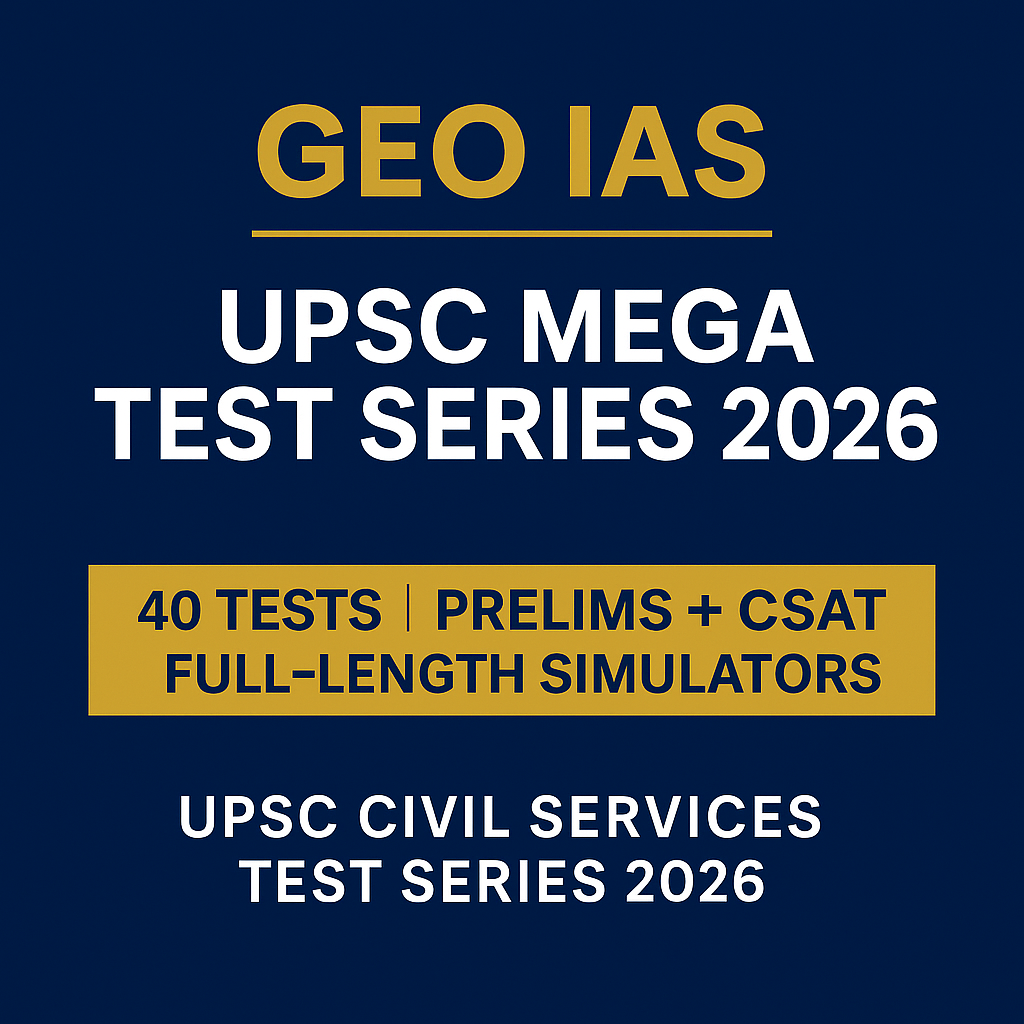
GEO IAS presents the UPSC MEGA TEST SERIES 2026, a premium 40-test program designed exactly on the UPSC 2020–2025 pattern, including 36 GS tests and 4 CSAT tests with a complete 9-phase coverage plan. The series features UPSC-level simulators, topic-wise and PYQ-based tests, Budget & Economic Survey special tests, bilingual explanations, national ranking, and both offline + online modes. If you want real UPSC-level practice and accurate exam simulation, this is the most trusted test series.
GEO IAS प्रस्तुत करता है UPSC MEGA TEST SERIES 2026, एक प्रीमियम 40-टेस्ट कार्यक्रम जिसे UPSC 2020–2025 के पैटर्न पर बिल्कुल तैयार किया गया है, जिसमें 36 GS और 4 CSAT टेस्ट शामिल हैं और पूरा सिलेबस 9-फेज प्लान में कवर किया जाता है। इसमें UPSC-लेवल सिमुलेटर, टॉपिक-वाइज और PYQ आधारित टेस्ट, बजट और आर्थिक सर्वे विशेष टेस्ट, द्विभाषी समाधान, नेशनल रैंकिंग और ऑफ़लाइन + ऑनलाइन दोनों मोड उपलब्ध हैं। यदि आप वास्तविक UPSC स्तर की तैयारी और सटीक परीक्षा अनुभव चाहते हैं, तो यह सबसे भरोसेमंद टेस्ट सीरीज़ है।
🔵 T1 — Polity NCERT +
Basics
Detailed Syllabus:
- NCERT
Political Science (6–12) — complete line-by-line coverage
- Meaning
of State, Government, Nation, Society
- Citizenship:
concept, constitutional position, types of citizenship, CAA context
- Political
ideologies: democracy, liberalism, socialism, secularism
- Rights
& duties: constitutional vs legal, negative vs positive rights
- Justice,
liberty, equality — philosophical meaning & UPSC relevance
- Constitution:
why needed, features, basic values, constitutional morality
- Historical
background: Regulating Act, Pitt’s Act, Charter Acts, 1858 Act, 1909,
1919, 1935
- Constituent
Assembly: committees, members, debates, adoption
- Basic
Structure doctrine: essence + cases (Kesavananda etc.)
- Separation
of Powers, Rule of Law
- Government
systems: parliamentary, presidential, federal, quasi-federal
Sources: NCERT 6–12, Laxmikant Intro Chapters
UPSC Trend: High weightage on conceptual polity & rights-based questions
🔵 T2 — Constitution (Laxmikant Part I)
Detailed Syllabus:
- Preamble:
keywords, debates, 42nd Amendment impact
- Salient
features: blend of rigidity-flexibility, quasi-federalism, parliamentary
system
- Parts
& Schedules of Constitution: significance + important articles
- Citizenship
(Art. 5–11) + Constitutional Amendments related
- Fundamental
Rights:
- Equality
(14–18)
- Freedom
(19–22)
- Protection
rights (23–24)
- Cultural
& Educational (29–30)
- Constitutional
remedies (32)
- Writs:
HC vs SC differences
- DPSP
(36–51): classifications & implementation challenges
- Fundamental
Duties (51A): origins & cases
- Constitutional
Amendments: 24th, 25th, 42nd, 44th, 52nd, 61st, 73rd, 74th
Sources: Laxmikant Chapters 1–19
UPSC Trend: Preamble + FR + DPSP dominate 60% of polity MCQs
🔵 T3 — Federalism +
Constitutional Bodies
Detailed Syllabus:
- Federalism:
cooperative vs competitive; unitary tilt; strong centre
- Centre–State
relations:
- Legislative
(List system, Art. 245–255)
- Administrative
(IAS, IPS, All India Services)
- Financial
(Finance Commission, GST Council)
- Inter-State
Relations: interstate councils, water disputes, tribunals
- Emergency
Provisions:
- National
(352)
- State
(356)
- Financial
(360)
- Local
Government:
- 73rd
& 74th Amendments
- Panchayati
Raj Structure
- Municipal
framework
- Constitutional
Bodies:
- Election
Commission
- UPSC
- CAG
- Finance
Commission
- Attorney
General & Advocate General
- Statutory
& Executive Bodies:
- NHRC,
CVC, CIC, Lokpal
- Parliamentary
System:
- President,
VP, PM, Cabinet
- Parliament:
LS, RS, Committees
Sources: Laxmikant Chapters 20–50
UPSC Trend: Highest scoring area in Polity
🔵 T4 — Polity PYQs +
Mixed Test
Detailed Syllabus:
- Full
PYQ set from 2011–2025 (topic-wise)
- High-weightage
themes: FR, federalism, bodies, emergency, parliament
- Repeated
PYQ patterns:
- Statements-based
tricky FR questions
- Polity
+ current affairs fusion questions
- Comparisons
(rights vs duties, HC vs SC, ECI powers vs actual functioning)
- Key
judgments impacting PYQs:
- Shreya
Singhal
- Puttaswamy
Privacy
- Sabarimala
- NJAC
case
T5 — Ancient + Medieval India (NCERT + Standard Books)
Detailed Syllabus:
1. Prehistoric India (UPSC hot topic)
- Paleolithic,
Mesolithic, Neolithic cultures — tools, sites, lifestyle
- Important
sites: Bhimbetka, Hunsgi, Belan Valley
- Food
production, domestication, settlements
2. Indus Valley Civilization
- Origin,
phases, town planning, economy, script theories
- Social
structure, religion, decline theories
- All
major sites: Harappa, Mohenjodaro, Dholavira, Rakhigarhi
- Recent
discoveries (UPSC 2025 trend)
3. Vedic Age (Early & Later)
- Social,
political, economic, religious life
- Expansion
to Ganga valley
- Polity:
Sabha, Samiti, Rajan, Vrajapati
- Religious
evolution → Upanishadic thought
4. Mahajanapadas & Rise of States
- 16
Mahajanapadas
- Rise
of Magadha — Nandas
- Causes
of growth of monarchy
5. Buddhism & Jainism
- Life
of Buddha & Mahavira
- Doctrine:
4 Noble Truths, 8-Fold Path, Syadavada, Anekantavada
- Councils,
spread, decline
- Sites,
patronage, architecture
6. Mauryan Empire
- Chandragupta
Maurya, Bindusara, Ashoka
- Administration,
Economy, Espionage
- Ashokan
edicts
- Decline
theories
7. Post-Mauryan Age
- Indo-Greeks,
Shakas, Parthians
- Satavahanas,
Kushanas (Kanishka)
- Sangam
Age literature
8. Gupta Age
- Golden
Age features
- Science,
technology, coins, culture
- Hiuen
Tsang accounts
9. Harsha + Early Medieval
- Harshavardhana
- Chalukyas,
Pallavas, Rashtrakutas
Medieval India
1. Delhi Sultanate
- Slave,
Khilji, Tughlaq, Sayyid, Lodi
- Land
revenue, military reforms
- Architecture
2. Mughal Empire
- Babur
to Aurangzeb
- Mansabdari,
Jagirdari
- Art,
architecture, literature
- Decline
theories
3. Bhakti & Sufi Movement
- Nirguna/Saguna
bhakti
- Sufi
silsilas
- Social
reform impact
Sources:
NCERT 6–12 History, Tamil Nadu Board, RS Sharma, Satish
Chandra
🔵 T6 — Modern India (Spectrum + NCERT + Bipin
Chandra)
Detailed Micro-Syllabus:
1. Advent of Europeans
- Portuguese,
Dutch, French, British competition
2. British Expansion (1757–1857)
- Battles
of Plassey, Buxar
- Subsidiary
Alliance, Doctrine of Lapse
- British
revenue systems
3. Social-Religious Reform Movements
- Brahmo
Samaj, Arya Samaj, Aligarh Movement
- Young
Bengal, Ramakrishna Mission
- Women
reforms
4. 1857 Revolt (UPSC favourite)
- Causes,
nature, centres, leaders
- Failure
reasons
- Historiographical
interpretations
5. Formation of INC
- Moderate
phase
- Extremist
phase
- Partition
of Bengal
- Surat
Split
6. Gandhi Era (1915–1947)
- Champaran,
Kheda, Ahmedabad
- Non-Cooperation
- Civil
Disobedience
- Round
Table Conferences
- Quit
India
7. Constitutional Developments
- Minto-Morley,
Montagu-Chelmsford
- Simon
Commission
- Indian
Councils Acts
- Cabinet
Mission Plan
- Indian
Independence Act
8. Revolutionaries
- Bhagat
Singh, Chandra Shekhar Azad, Revolutionary groups
9. Peasant + Tribal Movements
- Santhal,
Munda, Tebhaga, Indigo revolt
10. Post-Independence consolidation (basics)
Sources:
Spectrum, Bipin Chandra, NCERTs, GEO IAS Module
🔵 T7 — Modern India PYQs
+ Advanced Revision Test
Detailed Syllabus:
- UPSC
PYQs 2011–2025 (100% coverage)
- Trend-based
topics:
- 1919
Act
- 1935
Act
- Gandhi-associated
movements
- Socio-religious
reform movements
- Peasant
revolts
- Repeated
question models from:
- Satyagraha
theory
- INC
Sessions & Presidents
- 1931
Karachi Resolution
- Cripps
Mission vs Cabinet Mission
- Key
historical figures mapping
- Statement-based
tricky questions
- Integrated
A&C + modern linkage
🔵 T8 — Art & Culture
(Nitin Singhania + NCERT)
Detailed Micro-Syllabus:
1. Indian Architecture
- Harappan
architecture
- Buddhist
chaitya, vihara, stupas
- Mauryan
pillars
- Gandhara,
Mathura, Amaravati
- Temple
architecture:
- Nagara,
Dravida, Vesara
- Kalinga,
Bhumija, Maru-Gurjara
- Indo-Islamic
architecture:
- Arcuate
vs trabeate
- Delhi
Sultanate styles
- Mughal
architecture
- Modern
architecture
2. Indian Sculpture & Iconography
- Vaishnava,
Shaiva, Shakta iconography
- Chola
bronze sculpture
3. Painting Schools
- Ajanta,
Ellora, Bagh
- Rajput,
Mughal, Pahari, Deccan schools
4. Indian Music
- Hindustani
vs Carnatic
- Gharanas
- Instruments
(UPSC 2020 trend)
5. Indian Dance Forms
- Classical
(8 classical dances)
- Folk
dances (state-wise)
6. UNESCO World Heritage Sites
- Cultural,
natural, mixed sites
- UPSC
PYQs
7. Literature & Religious Texts
- Vedas,
Upanishads, Puranas
- Sangam
Literature
- Buddhist
& Jain texts
🔵 T9 — History + Art
& Culture Mixed (Integration Test)
Detailed Syllabus:
- Cross-topic
integration:
- Gupta
→ Classical arts
- Mauryan
→ Stupas & pillars
- Mughal
→ Miniature paintings
- Sangam
→ Culture + polity
- UPSC-style
integration:
- Buddhism
+ A&C
- Gupta
science + literature
- Medieval
architecture + polity
- PYQs
covering combined domains
- Advanced
2-statement & 3-statement tricky questions
- Chronology-based
questions (UPSC favourite)
🔵 T10 — Physical
Geography (NCERT + Goh Cheng Leong)
⭐ Detailed Micro-Syllabus:
1. Earth: Origin & Structure
- Nebular
& Planetesimal hypotheses
- Earth's
interior: crust, mantle, core
- Seismic
waves & shadow zones
- Continental
drift, Plate tectonics
2. Latitudes, Longitudes & Basics
- Heat
zones, time zones
- International
Date Line
- Great
circle & Rhumb line
3. Motions of Earth
- Rotation
& revolution
- Seasons,
solstices, equinoxes
- Daylight
variations
4. Geomorphology
- Weathering
(chemical, mechanical, biological)
- Erosion
agents: River, Wind, Glacier, Sea waves
- Landforms:
- Fluvial
(meander, oxbow, delta)
- Aeolian
(dunes, Yardang)
- Glacial
(aretes, moraines)
- Coastal
(beaches, spits, bars)
- Volcanoes:
types, distribution
- Earthquakes:
focus, epicenter, intensity scales
5. Rocks & Minerals
- Rock
cycle
- Igneous,
Sedimentary, Metamorphic
- Mineral
resources basics
6. Climatology (UPSC high-weight)
- Heat
budget
- Temperature
distribution
- Atmospheric
pressure belts
- Planetary
winds
- Monsoons:
mechanisms, global impact
- Jet
streams
- Tropical
cyclones vs temperate cyclones
7. Oceanography
- Ocean
floors, continental shelf
- Ocean
currents
- Waves
& tides
- El Niño, La Niña, ENSO, IOD
Sources:
NCERT 6–12, G.C. Leong, Oxford Atlas
🔵 T11 — Indian Geography
(NCERT + Oxford Atlas)
⭐ Detailed Micro-Syllabus:
1. Physiographic Divisions
- Himalayas:
formation, structure, ranges
- Indo-Gangetic
plains: sections, agriculture
- Peninsular
plateau: Deccan, Central Highlands
- Coastal
plains & islands
2. Drainage Systems (UPSC PYQ hotspot)
- Himalayan
rivers: Indus, Ganga, Brahmaputra
- Peninsular
rivers: Godavari, Krishna, Kaveri, Narmada, Tapi
- River-linking
projects
3. Climate of India
- Indian
monsoon mechanisms
- Western
Disturbances
- Jet
streams & El Niño impact
- Climatic
regions of India
4. Soils of India
- Alluvial,
Black, Red, Laterite, Desert, Mountain
- Soil
degradation: salinization, erosion, desertification
5. Natural Vegetation
- Tropical
evergreen, deciduous, thorn, montane, mangrove
- Reserved,
protected, unclassed forest
6. Agriculture
- Kharif/Rabi
cropping patterns
- Green
revolution zones
- Millets,
pulses, oilseeds
- Irrigation
systems
7. Minerals & Industries
- Coal,
iron ore, bauxite, mica
- Industrial
corridors
- Oil
refineries
8. Transport & Infrastructure
- Railway
zones
- Ports
(major + non-major)
- National
Highways
Sources:
NCERTs, Oxford Atlas, Map practice
🔵 T12 — India & World
Mapping (High Accuracy Test)
⭐ Detailed Micro-Syllabus:
1. Indian Mapping
- Location
of major cities
- State
borders & neighbours
- Rivers
+ tributaries
- National
Parks, Tiger Reserves
- Ramsar
Wetlands
- Mountain
passes (UPSC 2023 trend)
- Ports,
airports, industrial hubs
2. World Mapping
- Continents,
oceans
- Important straits (Hormuz, Malacca,
Bosporus)
- World
deserts, mountains (Andes, Rockies, Alps)
- Rivers
(Nile, Amazon, Yangtze)
- Political
geography:
- West
Asia (UPSC favourite)
- Europe
(NATO, EU)
- Africa
(countries around lakes, Sahel region)
3. Current Affairs Mapping
- Ukraine
crisis mapping
- Israel–Palestine
mapping
- Red
Sea shipping lanes
- Indo-Pacific
region
Sources:
Oxford Atlas, Orient Blackswan Atlas, Map-based PYQs, GEO
IAS Module
🔵 T13 — Geography +
Environment Integrated Test
(One of the most important tests)
⭐ Detailed Micro-Syllabus:
1. Linking Physical Geography with Environment
- Biogeochemical
cycles (carbon, nitrogen, water cycle)
- Biodiversity
hotspots
- Ecotones
& ecological niches
2. Climate + Ecology Integration
- Monsoon
→ vegetation → biodiversity
- Deserts
→ drought → climate adaptation
- Himalayas
→ glaciers → river systems
3. Environment Acts + Geography context
- Forest
Conservation Act
- Biodiversity
Act
- Wildlife
Protection Act
4. UPSC-style integrated statements
- Climate
→ Cyclones → Indian coasts
- El
Niño → Rainfall → Agriculture
- Rivers
→ species diversity
5. PYQ-based models
- Map
+ environment combined questions
- Climate
+ pollution + geography
🔵 T14 — Geography PYQs +
Advanced Application Test
⭐ Detailed Micro-Syllabus:
1. UPSC PYQs (2011–2024)
Topic-wise:
- Cyclones
- Jet
streams
- El
Niño & IOD
- Rivers
& dams
- Forest
types
- Mineral
belts
2. High-difficulty model tests
- 3-statement
analytical type
- Assertion–Reasoning
models
- Which
of the following pairs are correctly matched? type questions
3. Integrated questions
- Map
+ climate + ecology
- Soil
+ rainfall + agriculture
4. Applied questions
- Climate
change impact on crops
- Himalayan
vulnerability
- Coastal
erosion
🔵 T15 — Economy NCERT
Basics (Class 9–12 + Intro Concepts)
⭐ Detailed Micro-Syllabus:
1. Basic Economic Concepts (UPSC conceptual focus)
- Scarcity,
choice, opportunity cost
- Production
possibilities curve (PPC)
- Demand
& Supply (determinants, shifts, elasticity)
- Types
of markets: perfect, imperfect, monopoly, oligopoly
2. National Income (Class 12 NCERT)
- GDP,
GNP, NNP, NDP, Disposable Income
- GDP
at factor cost vs market price
- Real
vs nominal GDP
- GDP
deflator
- Methods:
Product, Income, Expenditure
- Base
year changes
3. Money & Banking (NCERT basics)
- Barter,
Money supply (M1–M4)
- Commercial
banks: credit creation
- RBI:
functions, monetary policy basics
4. Government Budgeting Fundamentals
- Revenue
vs capital receipts
- Budget
deficit types
- FRBM
basics
5. Inflation Basics
- CPI,
WPI
- Headline
vs core inflation
- Deflation,
disinflation, stagflation
6. External Sector Basics
- Balance
of Payments
- Current
& capital account
- Exchange
rates (fixed, floating)
- Devaluation
vs depreciation
Sources: NCERT (9–12 Economics), Indian Economy NCERT
Macroeconomics
UPSC Trend: Conceptual questions rising since 2018
🔵 T16 — Indian Economy
(Standard Books: Ramesh Singh, Sanjeev Verma)
⭐ Detailed Micro-Syllabus:
1. Economic Growth & Development
- HDI,
MPI
- Poverty
estimations
- Inequality
→ Gini coefficient
2. Planning in India
- Five-Year
Plans (summary)
- NITI
Aayog functions, cooperative federalism
3. Agriculture Sector
- Cropping
patterns
- MSP,
PDS, buffer stock
- Green
Revolution & contemporary issues
- Contract
farming, e-NAM, PM-AASHA
4. Industrial Sector
- Industrial
policies (1956, 1991)
- MSME
sector
- Make
in India, Production-linked incentives (PLI)
- Startups,
FDI norms
5. Infrastructure
- Rail,
road, ports, airports
- Sagarmala,
Bharatmala
- Logistics
Performance Index
- Energy
sector basics
6. Banking & Financial Sector
- NPAs,
IBC, Basel norms
- Bank
types
- Financial
inclusion: PMJDY, JAM, DBT
- NBFCs,
payment banks, small finance banks
7. Taxation System
- GST
basics
- Direct
vs indirect taxes
- Fiscal
federalism basics
Sources: Ramesh Singh, Sanjeev Verma, Economic Survey
overview, GEO IAS Module
UPSC Trend: Economy increasingly CA-driven but static
remains foundational
🔵 T17 — Economy Current
Affairs (without Budget/Survey)
⭐ Detailed Micro-Syllabus:
1. Monetary Policy Updates
- Repo,
reverse repo, SDF, MSF
- MPC
decisions
- Inflation-targeting
framework
2. Banking Sector Developments
- Digital
banking, UPI growth
- Cyber-security
issues
- RBI
guidelines
3. Indian Growth Trends
- GDP
quarterly trends
- Sectors
leading growth
- Unemployment
data (PLFS)
4. External Sector
- India’s
forex reserves trends
- Global
supply-chain shifts
- India–UAE
CEPA
- India–Australia
ECTA
5. Social Sector Reform Updates
- Health
missions
- Education
policy initiatives
- Social
protection systems
6. Infrastructure & Energy
- Renewable
energy targets
- Green
hydrogen mission
- EV
policy developments
7. Important Indices
- HDI,
GHI, EPI, GFSI, GCI
Sources: PIB, Hindu, Mint, Economic Survey highlights,
GEO IAS Module
UPSC Trend: 40–50% economy questions link to CA
indirectly
🔵 T18 — Money, Banking
& Inflation (Advanced)
⭐ Detailed Micro-Syllabus:
1. Monetary Policy (Deep Coverage)
- Repo,
reverse repo, CRR, SLR, OMO, MSS
- Liquidity
management by RBI
- Inflation
targeting
- MPC
structure, term, powers
- RBI
vs Government autonomy debates
2. Banking System
- Public,
private, cooperative banks
- NBFC
classification
- Priority
sector lending
- Financial
stability concerns
- Digital
currency (CBDC) basics
3. Inflation
- Causes:
demand-pull, cost-push
- Core
inflation, headline inflation
- Philips
curve
- RBI
inflation management
4. Financial Markets
- Capital
markets: SEBI, stock exchanges
- Money
markets: T-bills, CDs, CPs
- Bond
markets basics
5. Government Securities
- G-secs
- SDLs
- RBI
market operations
Sources: Ramesh Singh, RBI Annual Report, GEO IAS Module
UPSC Trend: Frequently tested area (2015–2024)
🔵 T19 — Economy PYQs +
Analytical Revision Test
⭐ Detailed Micro-Syllabus:
1. PYQs (2011–2024) Complete Coverage
Topic-wise:
- Monetary
policy
- Banking
- External
sector
- Budget
terms
- FDI/FII
- Agriculture
economics
2. High-difficulty model questions
- Complex
“select the correct code” questions
- PYQ-inspired
tricky statements
- Matching
schemes with ministries
3. Integrated Economy Questions
- Inflation
→ RBI → growth
- External
sector → exchange rates → exports
- Fiscal
→ monetary linkages
4. Trend-based analysis
- How
UPSC shifted from static → applied economics
- High-return
vs low-return topics
.
🔵 T20 — Ecology +
Biodiversity (Foundational)
⭐ Detailed Micro-Syllabus:
1. Ecology Basics (UPSC conceptual zone)
- Ecology,
ecosystem, ecotone, ecological niche
- Food
chain, food web, trophic levels
- Ecological
pyramids (energy, biomass, number)
- Biogeochemical
cycles: carbon, nitrogen, sulphur, phosphorus
2. Ecosystem Types
- Terrestrial
ecosystems
- Aquatic
ecosystems
- Mangroves,
wetlands, coral reefs
3. Biodiversity Concepts
- Genetic,
species, ecosystem diversity
- Bioprospecting
vs bio-piracy
- Biocapacity,
ecological footprint
4. Threats to Biodiversity
- Habitat
loss
- Invasive
species (UPSC favourite)
- Climate
change
- Pollution
- Overexploitation
5. In-Situ & Ex-Situ Conservation
- Protected
area network:
- National
Parks
- Wildlife
Sanctuaries
- Tiger
reserves
- Biosphere
reserves
- Zoos,
gene banks, seed banks
6. IUCN Red List
- Threat
categories
- UPSC-relevant
species (Gharial, Snow Leopard, Indian Pangolin, Olive Ridley, Great
Indian Bustard)
7. Biodiversity Hotspots
- Western
Ghats
- Himalayas
- Indo-Burma
- Sundaland
Sources: NCERT 12 Biology, Shankar IAS Environment, GEO
IAS Module
UPSC Trend: High-scoring conceptual area (6–10 questions
each year)
🔵 T21 — Forests +
Wildlife + Protected Areas
⭐ Detailed Micro-Syllabus:
1. India’s Forest Types (Champion & Seth
classification)
- Tropical
evergreen
- Tropical
deciduous
- Thorn
- Montane
- Mangroves
- Littoral
& swamp
2. Wildlife Conservation
- Flagship
species
- Keystone
species
- Endemic
species
- Migratory
species (CMS listings)
3. Protected Area Categories
- National
parks
- WLS
- Conservation
reserves
- Community
reserves
- Biodiversity
heritage sites
4. International Conventions
- CITES
- CMS
- IUCN
- Ramsar
- World
Heritage Convention
5. Tiger Conservation
- Project
Tiger
- NTCA
- Tiger
census methodology
- Tiger
reserves mapping
6. Elephant Conservation
- Project
Elephant
- Elephant
corridors
- Human-animal
conflict
7. Important Species Topics
- Crocodile
species in India
- Rhino
conservation
- Snow
leopard & Himalayas
- Vultures
& diclofenac issue
Sources: Shankar IAS, MoEFCC annual report, GEO IAS
Module
UPSC Trend: Mapping + species + conventions form majority
of questions
🔵 T22 — Environment
Current Affairs (1-Year Coverage)
⭐ Detailed Micro-Syllabus:
1. Climate Reports & Indices
- IPCC
(6th assessment cycle)
- UNEP
Emissions Gap Report
- UNFCCC
updates
- Global
Climate Risk Index
- State
of the Climate Report
2. Indian Environmental Policies
- National
Clean Air Programme (NCAP)
- Green
Hydrogen Mission
- PM
Ujjwala, UJALA, Solar Mission
- E-waste
management rules update
- Forest
Conservation Amendment Act
3. International Summits
- COP-28
outcomes
- Paris
Agreement updates
- Global
Stocktake findings
4. Environmental Disasters & Case Studies
- Cyclones
(Mocha, Biparjoy)
- Heatwaves
trends
- Floods
& urban flooding
5. Critical Ecosystems
- Western
Ghats ESA
- Great
Nicobar project (UPSC favourite)
- Aravalli
protection issues
6. Species in News
- Dugong
conservation
- Lion
translocation
- Leopard
census
- New
species discoveries
Sources: MoEFCC, PIB, Down to Earth, Hindu SciTech, GEO
IAS Module
UPSC Trend: 50% of environment questions link directly to
CA
🔵 T23 — Climate Change +
Agreements
⭐ Detailed Micro-Syllabus:
1. Climate Basics
- Greenhouse
gases
- Radiative
forcing
- Global
warming vs climate change
2. Climate Models & Phenomena
- El Niño, La Niña, ENSO, IOD
- Arctic
warming + India impact
- Jet
stream shifts + monsoon
3. International Climate Treaties
- Kyoto
Protocol
- Paris
Agreement
- Montreal
Protocol (UPSC favourite)
- Kigali
Amendment
- UNFCCC,
IPCC
4. India's Climate Policies
- National
Action Plan on Climate Change (NAPCC)
- National
Missions (Solar, HEMM, Green India)
- NDC
targets
5. Carbon Markets & Environmental Economics
- Carbon
credits
- Clean
Development Mechanism (CDM)
- Carbon
border adjustment
6. Climate Adaptation & Mitigation
- REDD+
- Adaptation
fund
- Nature-based
solutions
Sources: Shankar IAS, UNFCCC docs, GEO IAS Module
UPSC Trend: UPSC repeats climate treaty-based questions
every alternate year
🔵 T24 — Environment PYQs
+ Applied Concepts Test
⭐ Detailed Micro-Syllabus:
1. PYQs (2011–2024) Topic-Wise
- Pollution
- Ecology
- Climate
- Protected
areas
- Species
- Acts
2. Applied Environment Questions
- Ecological
succession
- Food
chain dynamics
- Pollution
control technologies
- Bio-remediation
- Wetland
conservation
3. Mapping-based Environment
- National
parks
- Tiger
reserves
- Biosphere
reserves
- Ramsar
sites
4. Advanced UPSC patterns
- 3-statement
elimination
- Which
of the following pairs…
- Consider
the following organisms…
🔵 T25 — Static Science
& Technology (NCERT Class 6–12)
⭐ Detailed Micro-Syllabus:
1. Physics Basics (NCERT 6–12)
- Motion,
force, gravitation
- Work,
energy, power
- Light
(reflection, refraction), optics concepts
- Electricity:
current, resistance, power
- Magnetism
basics
- Sound
waves
- Nuclear
physics (radioactivity, fission, fusion)
2. Chemistry Fundamentals
- Atomic
structure
- Periodic
table trends (UPSC favourite)
- Chemical
bonding
- Acids,
bases, salts
- Organic
chemistry basics
- Polymers,
alloys, chemicals in daily life
3. Biology: Foundation Topics
- Cell
structure & functions
- Tissues
- Photosynthesis,
respiration
- Reproduction
- Human
physiology: digestion, blood circulation, nervous system
- Immunity
basics
4. Biotechnology Basics
- DNA,
RNA, genes
- Genetic
engineering
- GM
foods
- PCR,
CRISPR basics
5. Space Basics
- Planets,
satellites, comets
- Light
year, astronomical unit
- Kepler’s
laws
6. Computers & IT Basics
- Binary,
byte, memory units
- Input/output
devices
- Networking
basics
- Cloud
computing fundamentals
Sources: NCERT Class 6–12 Science, Lucent (Science
part)
UPSC Trend: 1–3 direct questions from basic science every year
🔵 T26 — New Technologies:
AI, Space, Biotech, Cybersecurity
(A crucial UPSC area since 2018)
⭐ Detailed Micro-Syllabus:
1. Artificial Intelligence
- Machine
learning, deep learning basics
- NLP,
computer vision
- Ethical
AI
- Government
policies on AI
- AI
applications: health, agriculture, governance
2. Robotics & Automation
- Industrial
automation
- Drones
(DGCA rules)
- Robotics
in manufacturing, defense
3. Space Technology (ISRO Heavy Weight Area)
- PSLV,
GSLV, LVM3
- Chandrayaan-1,
2, 3
- Aditya
L1
- XPoSat
- NavIC
vs GPS
- Reusable
launch vehicles
- Space
debris, Kessler syndrome
4. Biotechnology (Advanced)
- Recombinant
DNA technology
- Gene
editing (CRISPR)
- Gene
therapy
- Vaccine
technology (mRNA, DNA vaccine)
- Bioinformatics
5. Nanotechnology
- Carbon
nanotubes
- Graphene
- Nanomedicine
- Nanotoxicity
concerns
6. Cybersecurity & IT
- Encryption,
hashing
- Cyberattacks:
phishing, ransomware
- CERT-In
- Zero
Trust architecture
- 5G
+ cybersecurity vulnerabilities
7. Defense Technology
- Hypersonic
weapons
- Drone
warfare
- Missile
systems (Agni, Prithvi, BrahMos)
- S-400,
Iron Dome basics
Sources:
PIB Science & Tech, ISRO publications, AICTE SciTech
notes
UPSC Trend: ~8–12 SciTech questions every year
🔵 T27 — Science &
Tech Current Affairs (1-Year Coverage)
⭐ Detailed Micro-Syllabus:
1. Space Updates
- Chandrayaan-3
soft landing
- Gaganyaan
mission updates
- New
ISRO launches (SSLV, NVS satellites)
- Private
space companies (Skyroot, Agnikul)
2. Biology & Health Science Updates
- WHO
reports
- New
diseases, pandemics
- mRNA
technologies
- Genome
sequencing
- One
Health approach
- Antibiotic
resistance
3. AI/IT Developments
- IndiaAI
Mission
- Semiconductor
mission
- Quantum
computing initiatives
- Cybersecurity
incidents (CERT-In alerts)
4. Environment-linked Tech
- Climate
modelling
- Carbon
capture
- Green
hydrogen
- EV
battery technologies
5. New Scientific Discoveries
- Nobel
Prize highlights
- New
materials
- New
exoplanets
6. Agriculture S&T
- GM
mustard
- Nano-fertilizers
- Digital
agriculture tools
Sources:
PIB SciTech, Down to Earth Sci updates, Nature/Science
journals, GEO IAS Module
UPSC Trend: Majority of Science questions are CA-linked
🔵 T28 — Current Affairs:
Polity + Social Issues
⭐ Detailed Micro-Syllabus:
1. Polity Current Affairs (past 1 year)
- Supreme
Court judgments:
- Constitutional
Bench rulings
- Federalism
disputes
- Election
Commission reforms
- SC
verdicts on fundamental rights (Privacy, Free speech, Marriage rights
etc.)
- Parliament
updates:
- Major
Bills passed
- New
Acts
- Parliamentary
committee reports
- Election-related
CA:
- ECI
reforms
- Electoral
bonds judgment
- VVPAT
reforms
- Constitutional
developments:
- Centre–State
friction cases
- Governor–CM
conflicts (UPSC favourite)
- Delimitation
Panels
- Local
Governance updates:
- PRI
devolution rankings
- Urban
local body reforms
2. Social Issues (UPSC high weight)
- Women-related
legislation & schemes
- Juvenile
justice, child rights
- Education
reforms (NEP implementation)
- Health
sector updates:
- Ayushman
Bharat
- Digital
Health Mission
- Poverty,
hunger, inequality indices
- Social
justice & vulnerable sections
- Demographic
trends: fertility, migration
3. Government Schemes (full coverage)
- MoSPI,
MoWCD, MoHFW, MoRD major schemes
- Social
protection schemes
- New
initiatives from PIB
4. Reports, Indices & Rankings
- Democracy
Index
- Rule
of Law Index
- Human
Development Report
- Social
Progress Index
UPSC Trend: Polity + social CA now contribute 6–8
questions yearly
🔵 T29 — Current Affairs:
Economy + International Relations
⭐ Detailed Micro-Syllabus:
1. Indian Economy CA
- RBI
monetary policy updates
- Inflation
trends, food inflation spikes
- GST
Council meetings
- FDI
flows, FPI trends
- Make
in India + PLI updates
- Banking
reforms:
- NPA
trends
- IBC
updates
- Digital
payments growth (UPI, ONDC)
- Poverty,
inequality, unemployment data (PLFS)
- Energy
sector CA:
- Green
hydrogen mission
- Solar
capacity milestones
- Coal
vs renewable mix
2. Budget + Survey (Trends only)
(Full test on this is T31 — here only CA linkages)
- Fiscal
deficit trends
- Capital
expenditure focus
- Social
sector allocations
- Tax
updates
3. International Relations CA
- India–USA
strategic partnership
- India–Russia
defence & trade
- India–ASEAN,
India–EU summits
- QUAD,
IPEF, Indo-Pacific initiatives
- West
Asia CA:
- Israel–Palestine
- Iran–US
tensions
- Red
Sea shipping lanes
- Neighbourhood
updates:
- Sri
Lanka crisis recovery
- Maldives–India
relations
- Nepal
constitutional concerns
- China
& Indo-Pacific security
4. Global Institutions
- IMF,
World Bank, ADB reforms
- WTO
meetings
- UN
reforms debate
5. Important Economic Reports
- WEO
(IMF)
- Global
Trade Outlook (WTO)
- World
Investment Report (UNCTAD)
- Global
Economic Prospects
🔵 T30 — Current Affairs:
Environment + Science & Tech (CA-Heavy)
⭐ Detailed Micro-Syllabus:
1. Environment CA
- COP-28
outcomes
- IPCC
AR6 synthesis report
- Forest
Conservation Amendment Act
- Great
Nicobar Island project
- Western
Ghats ESA debate
- Wildlife
species in news
- Heatwave
thresholds (IMD)
- Air
quality alerts & NCAP updates
- Waste
management rules (2023 updates)
2. Climate Change CA
- Global
Stocktake
- Extreme
weather events (India 2024)
- Arctic
& Antarctic updates
- Renewable
energy milestones
3. Science & Tech CA
- Semiconductor
mission
- IndiaAI
Mission
- Quantum
computing initiatives
- Cybersecurity
challenges (CERT-In reports)
- ISRO
recent missions (Chandrayaan-3, Aditya-L1)
- Private
space startups (Agnikul, Skyroot)
- Vaccine
updates
- Genome
sequencing & One Health
4. Agriculture S&T
- Nano-urea
- Digital
agriculture platforms
- GM
crops (GM Mustard)
5. Reports & Indices
- State
of Climate Report
- Emissions
Gap Report
- India
Ranking: Climate & SDG
🔴 T31 — Budget + Economic
Survey + Government Affairs (Combined Document Test)
This is one of the most strategically important tests in the
entire series.
⭐ Detailed Micro-Syllabus:
1. Union Budget (FULL COVERAGE)
A. Budget Structure & Concepts
- Revenue
vs capital receipts
- Consolidated
Fund, Contingency Fund, Public Account
- Types
of deficits:
- Fiscal
- Revenue
- Primary
- Effective
revenue
- Capital
expenditure vs revenue expenditure
- FRBM
Act
B. Key Budget Components
- Tax
proposals (direct + indirect)
- GST
compensation trends
- Subsidy
reforms (food, fertilizer, petroleum)
- Fiscal
consolidation roadmap
- Budget
priorities for infrastructure, health, education, defense
C. Sector-Wise Budget Analysis
- Agriculture
& rural: MSP, PMFBY, PM-KISAN
- Health
& education allocations
- Urban
development (AMRUT, Smart Cities)
- Renewable
energy & climate financing
- Railways
& transport Corridors
- Digital
economy initiatives
2. Economic Survey (FULL COVERAGE)
A. Macroeconomic Overview
- GDP
growth projections
- Drivers
of growth
- Inflation
trends
- Employment
trends (PLFS)
- External
sector developments
B. Sectoral Analysis
- Agriculture
reforms
- Industrial
sector recovery
- Banking
& NPA trends
- Fiscal
developments
C. Thematic Chapters
- AI
& digital infrastructure
- Green
hydrogen economy
- Women-led
development
- Innovation
ecosystem
- Ease
of doing business updates
D. Key Charts & Data
- Tax
buoyancy
- Sectoral
growth charts
- Demographic
trends
- Credit
growth data
3. Government Affairs (Major Reports + Policies)
A. Constitutional & Governance Developments
- Major
Supreme Court judgments
- Federal
disputes (Governor vs State)
- Local
governance reforms
B. Government Committees & Reports
- Finance
Commission updates
- Parliamentary
committee recommendations
- National
Education Policy updates
- Health
Missions
C. Flagship Government Schemes (2023–25)
- PM
Gati Shakti
- Solar
Mission
- Ayushman
Bharat
- SAMARTH,
SAMPANN, SVAMITVA
- Aspirational
Districts & Aspirational Blocks
4. CA + Documents Integrated Questions
- Budget
+ economy linkages
- Survey
+ global economy linkages
- Governance
+ Parliament interactions
- Fiscal
policy + monetary policy synergy
⭐ T31 is designed to reproduce
5–7 UPSC questions each year which directly come from these documents.
🟪 T32 — Full Length Test
1 (Complete UPSC GS Paper–I Simulator)
⭐ Detailed Micro-Syllabus:
This test covers the entire UPSC GS Prelims syllabus:
1. Polity
- Full
Constitution
- Bodies
- Governance
+ polity-current fusion
2. History & A&C
- Ancient,
Medieval, Modern
- Architecture,
dances, literature
3. Geography
- Physical
+ Indian
- Maps
+ Climate + Oceanography
4. Economy
- Static
+ dynamic
- External
sector
- Banking
5. Environment
- Ecology,
species, protected areas, environment CA
6. Science & Tech
- Static
+ CA (ISRO + AI + biotech)
This test replicates actual UPSC 2023–2025 pattern:
→ 60% CA-linked static
→ 40% conceptual static
🟪 T33 — Full Length Test
2 (High Difficulty)
⭐ Detailed Micro-Syllabus:
- Complex
3-statement questions
- Polity
+ CA integrated
- Economy
diagrams and data-based questions
- Applied
geography (climate + ecology integration)
- Advanced
A&C classification
- Species,
acts, and treaties
- Deep
S&T CA (quantum, semiconductors, private space)
This test represents the toughest UPSC questions (like
2020, 2022).
🟪 T34 — Full Length Test
3 (Concept + Application Mix)
⭐ Detailed Micro-Syllabus:
- Concepts
from NCERT (foundational but applied)
- Polity
Case-based questions
- Economy
schemes + conceptual definitions
- Geography
+ map + phenomena-based questions
- Environment:
ecosystem processes + climate treaties
This test focuses on high-scoring conceptual clarity.
🟪 T35 — Full Length Test
4 (Current-Affairs Heavy)
⭐ Detailed Micro-Syllabus:
- 1-year
CA (Dec 2023 – Apr 2025)
- India
+ World geopolitics
- Economy
+ RBI updates
- Climate
+ COP outcomes
- ISRO
+ DRDO + Tech developments
- Environment
laws + amendments
- Species
in news
This test helps capture 80% of UPSC’s CA-linked questions.
🔵 T36 — GRAND FINAL
SIMCERT TEST
⭐ Detailed Micro-Syllabus:
This is the final mock replicating UPSC’s exact:
- Difficulty
- Topic
balance
- Unpredictability
- Elimination
traps
- Odd-one-out
patterns
- Statement
combos
Coverage Pattern:
- Polity
(20%)
- Environment
(20%)
- Economy
(20%)
- Geography
(20%)
- History
+ A&C (15%)
- S&T
(5%)
This test mimics the actual UPSC exam day psychology and
style.
⭐ Batch 9 — Detailed Syllabus
(CSAT–1 to CSAT–4)
Arithmetic, Reasoning, Comprehension, Data
Interpretation, Full-Length Simulator
🔵 CSAT–1 — Arithmetic +
Reasoning (Concept + Practice Test)
⭐ Detailed Micro-Syllabus:
1. Arithmetic (Class 10–12 Level)
- Number
system (integers, fractions, decimals)
- LCM,
HCF, divisibility rules
- Percentages
(profit-loss-discount)
- Ratios
& proportions
- Averages,
mixtures & alligation
- Simple
& compound interest
- Time–speed–distance
- Time
& work, pipes & cisterns
- Boats
& streams
- Clocks
& calendars basic problems
UPSC Trend:
UPSC CSAT no longer asks heavy calculations — instead, it
tests logic-heavy arithmetic.
2. Reasoning (Analytical + Logical)
- Coding–decoding
- Blood
relations
- Syllogism
- Direction
sense
- Seating
arrangement (linear + circular)
- Clocks,
sequences & series
- Pattern
recognition
- Odd-one-out
- Analogies
- Venn
diagrams
- Data
sufficiency
UPSC Trend:
More focus on analytical logic and less on
traditional bank-style reasoning.
3. Basic Data Interpretation
- Bar
charts
- Line
graphs
- Pie
charts
- Simple
table interpretation
4. Puzzles (Light Difficulty)
- Age-based
puzzles
- Ranking
questions
Sources: CSAT by Tata McGraw Hill, Arihant CSAT Manual
UPSC Pattern: Moderate but tricky; elimination is key
🔵 CSAT–2 — Comprehension
+ Aptitude (UPSC Trending Areas)
⭐ Detailed Micro-Syllabus:
1. Reading Comprehension (RC)
UPSC-level passages involving:
- Philosophy
- Economics
- Environment
- Social
issues
- Ethics
& morality
- Science
articles
Skills tested:
- Inference
- Assumption
- Tone
of author
- Logical
conclusion
UPSC prefers long analytical passages with subtle
twists.
2. Logical Aptitude
- Statement–argument
- Statement–assumption
- Strengthen/weaken
arguments
- Cause–effect
- Course
of action
- Critical
reasoning puzzles
This section has increased tremendously since 2021.
3. Verbal Reasoning
- Para-jumbles
- Odd-sentence
out
- Sentence
completion
4. Maths Reasoning
- Quant-based
logic puzzles
- Data-based
inference
🔵 CSAT–3 — Mixed CSAT
(Arithmetic + Reasoning + RC + DI)
⭐ Detailed Micro-Syllabus:
This test includes a balanced mix:
1. Quantitative Aptitude (40%)
- Application-based
arithmetic
- Ratio
problems
- Algebra
basics
- Geometry
basics (mensuration light level)
- Time–speed–distance
with diagrams
2. Logical Reasoning (30%)
- Multi-statement
puzzles
- Syllogisms
(UPSC pattern)
- Analytical
grouping
- Seating
arrangement
- Input–output
patterns (light)
3. Reading Comprehension (20%)
- Short
& long RC passages
- Inference-heavy
questions
4. Data Interpretation (10%)
- Moderate-level
DI
- Line,
bar, pie, table
- Multi-set
DI
🔵 CSAT–4 — Full Length
CSAT Simulator (UPSC CSAT Paper)
⭐ Detailed Micro-Syllabus:
This replicates the actual UPSC CSAT paper exactly:
1. Reading Comprehension (10–12 passages)
- Long
passages from:
- Philosophy
- Economics
- Psychology
- Sociology
- Environmental
science
- Questions
are NOT factual; they test:
- tone
- argument
- inference
- logical
structure
2. Reasoning (25–30 questions)
- Complex
puzzles
- Logical
sets
- Pattern
recognition
- Critical
reasoning
- Data
sufficiency
- Matching
patterns
3. Quantitative Aptitude (20–25 questions)
- Mostly
conceptual
- Many
traps
- Moderate
calculations
- Emphasis
on problem-solving logic
4. Data Interpretation
- Tough
DI sets
- Multi-graph
interpretation
- Trend
analysis
⭐ UPSC CSAT Trend:
- RC
+ reasoning now dominate
- Arithmetic
is conceptual, not computational
- UPSC
wants logical clarity, not lengthy maths
- CSAT
has become a qualifier, but NOT easy
Video Lectures
₹8,000Only
₹12,000Course Features
- Duration: 1 months 14 days
- Type: Popular
- Batch Starts: 06 Apr 2026